

Q: What’s it like being a whistleblower in a fraud investigation?
A: Absolutely, positively humiliating.
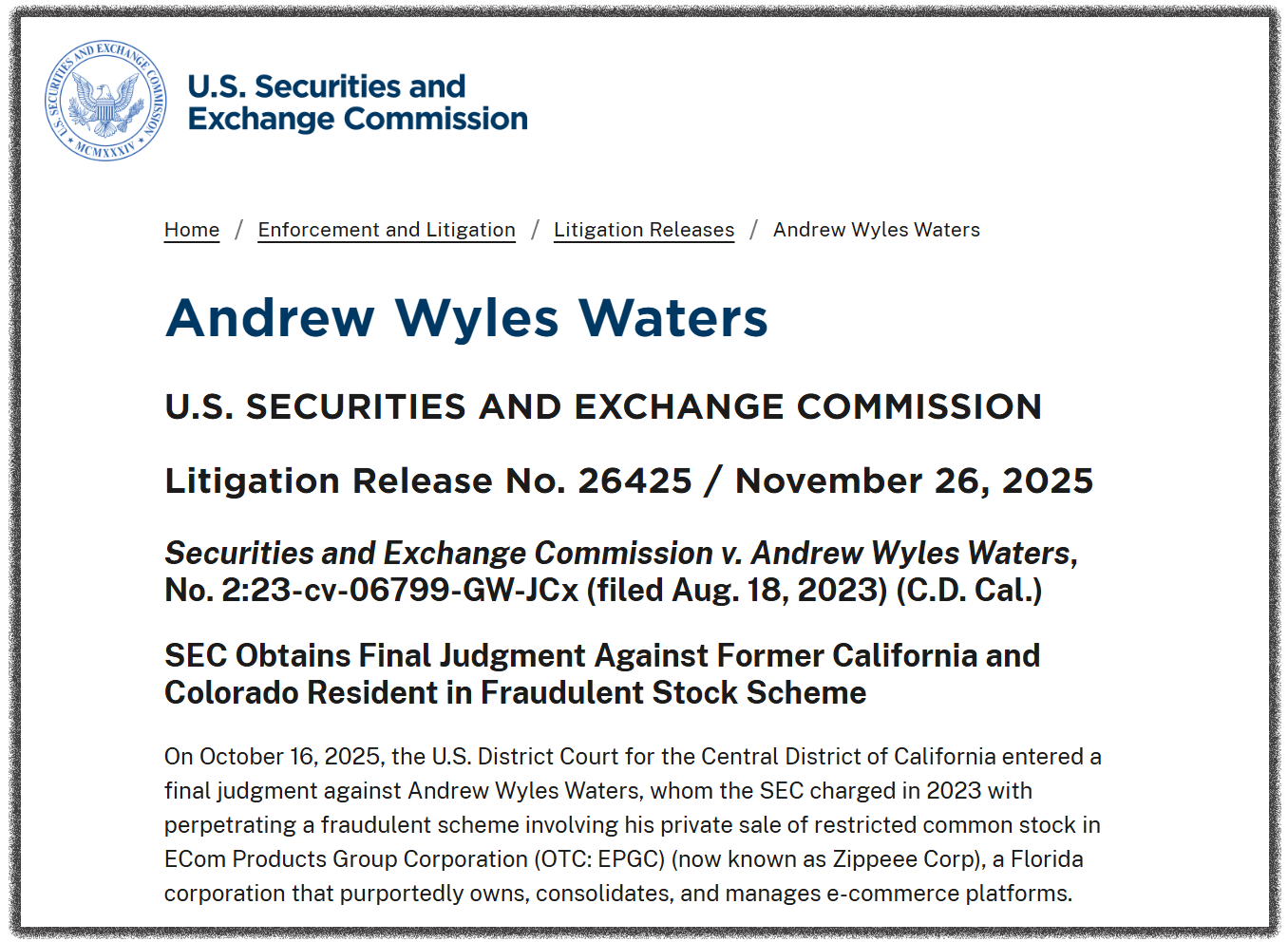
As was reported in 2023 in news outlets such as the Australian Financial Review, the Securities and Exchange Commission charged my former boss with Securities Fraud. Unfortunately, I was more than a middling employee with ECom Products Group Corporation, the company at the center of the fraud accusations. I was a member of the Board of Directors. I was the company’s Finance Director. Knowing only this, most people conclude one of two things: 1) I was in on it, or 2) I am an idiot.
I can only answer one of those two questions: I was not in on it.
Ultimately, I was a subpoenaed witness in two civil fraud lawsuits and one FBI criminal investigation into the actions of my former boss, Andrew Wyles Waters. Both of the fraud lawsuits resulted in default judgments against him. In retaliation for my cooperation with the investigations, Mr. Waters sued me for breach of contract and fiduciary duty, claiming that I had no right to turn over the evidence of his misdeeds. At the time I was served, I remember thinking this was laughable, but not being able to choke out a laugh.
It took more than a year and a mountain of legal fees to win the lawsuit Mr. Waters waged against me. In total, Mr. Waters and his companies presently owe about $6 million in State and Federal Court awarded judgments, including a quarter million dollars to me. He has not paid a penny, and who knows if he ever will.
While this particular story was important to those of us directly involved, it does not stand out in a swelling sea of frauds. The dollar amount in this case is only seven figures, the victim talley is modest, the perpetrator is forgettable. If you spend ten minutes perusing the SEC’s press releases detailing the hundreds and hundreds of millions stolen on a daily basis in this country, you will quickly understand what I mean. The only people who want to hear this story are the Securities and Exchange Commission and my therapist.
But a funny thing happened the moment Mr. Waters emerged from his curated anonymity to file a lawsuit against me. Unintentionally, his actions annointed me as the public face of a global underground community of people who claim to have been defrauded by him. Past, present, and — much to Mr. Waters’ chagrin — future investors, employees, and partners came out of the woodwork to share their personal stories of betrayal and ask of mine. Australia, China, the UK, Bali, the Netherlands, Colorado, Georgia, California: I have spoken with dozens caught in Andrew’s wake. Investors who lost their money, friends who lost their faith, employees who lost their livelihood, and partners who lost their businesses.
More than the pain of financial loss, what resonated each time I spoke with someone who shared their story was the sadness captured in the refrain, I thought he was my friend.
That is when I recognized that I had a story to tell after all, only it was not tied to the company, individuals, or details specific to my experience. The story was universal — free from the constraints of any one fraud or bad actor. It was a story about trust, deception, and ultimately, betrayal.
I got to work finding new inspiration for the plot elements in my story, and I didn’t have to look far. In Montecito’s own backyard, I found convicted fraudsters who used boutique wine and gourmet food to lure their victims. Those who dangled exclusive access to pre-IPO stocks. Those who dazzled investors with opaque foreign investments. Beyond Montecito’s borders, those who used their ill gotten gains to finance their love of horses. And of course, the international “pump and dump” frauds so legion that the SEC recently announced a special task force focused solely on cross-border fraud. The SEC’s archive of litigation releases are a wash, rinse, repeat of the same tricks, tools, and schemes perpetrated on hopeful Americans again and again and again. As King Solomon is said to have written, “there is nothing new under the sun.”
In the end, my personal experiences informed the emotional and psychological landscape of the story, but Montecito should not be read as a factual account of any actual persons or events. The characters, incidents, and circumstances in the book are not a portrayal of any real individuals or occurrences but a composite creation shaped by multiple sources, research, and imagination.
Chances are that you or someone you know has fallen victim to a scammer, con artist, or fraudster, and in that vein, elements of this story may seem familiar. Unfortunately, because man has been stealing from man since Jacob dressed in goat skins, that familiarity is purely a coincidence.